I've had quite a while (two years) to ruminate on this novel. While the phrasing of the prose might not be fresh, the lessons about love and marriage still are.
The novel begins with the infamous line, "It is a truth universally acknowledged, that a single man in possession of a good fortune, must be in want of a wife" (2). The amount of snark and sarcasm that Jane Austen manages to imbue in that line is legendary. But Austen has a base of truth in this statement. In Nineteenth-century England, a man, especially a wealthy one, was supposed to marry a woman of good virtue and character (and preferably a decent sized dowry) and produce heirs to continue on the family name and fortune. Getting married was not only the next step in a young person's life, it was their duty. Therefore, not all marriages were the best matches. Many were made for financial reasons, while others were marriages of passion. But with the successful couples in the novel, Austen argues that good marriages are based in mutual respect and grow stronger with time.
One of the first marriages we see in the novel is not a particuarlly successful one. Mr. and Mrs. Bennett married when they were young because Mr. Bennet fell for Mrs. Bennet's beauty. The novel states, "Her [Elizabeth's] father, captivated by youth and beauty, and that appearance of good humour with youth and beauty generally give, had married a woman whose weak understanding and illiberal mind had very early in their marriage put an end to all real affection for her. Respect, esteem, and confidence had vanished for ever; and all his views of domestic happiness were overthrown". This is an example of an unequal marriage. Mrs. Bennet is trite while Mr. Bennet is contemplative. They raise five daughters, only two of which make successful matches during the book, and this is mostly due to their own initiative and intelligence.
Lydia was not one of the daughters that made a good match. She elopes with George Wickham. Originally, they just run away together. But, Darcy finds them and forces Wickham to make an honest woman out of her. Lydia is fated to have the same type of marriage that her parents had, a loveless one based on initial attraction. While Wickham is not quiet like Mr. Bennet, his pairing with Lydia is not based in mutual love and respect. Lydia just wanted to get married for the sake of getting married. Elizabeth characterizes her as "untamed, unabashed, wild, noisy, and fearless". Granted, Lydia is fifteen at the start of the novel and refuses to follow anyone's example except her mother's. But, that does not excuse her rash behavior and that Darcy cleans up the mess she makes for the entire Bennet family.
While Lydia follows the example of her mother, Jane tries to follow Elizabeth's advice. While that advice ends up almost ruining Jane and Bingley's relationship, they still end up happily coupled in the end. Elizabeth tells Jane, "Indeed, Jane, you ought to believe me. No one who has ever seen you together can doubt his affection. Miss Bingley, I am sure, cannot. She is not such a simpleton. Could she have seen half as much love in Mr. Darcy for herself, she would have ordered her wedding clothes. But the case is this: We are not rich enough or grand enough for them". This raises another important theme in the novel: class and society. While Jane and Bingley possess one of the best relationships in the novel, they undergo the trial of a judgmental society. Bingley is significantly wealthier than the Bennet family and society believes that Jane only wants to marry him for his money and status. But, Jane is innocent and pure of heart. She wants to marry Bingely because she loves and respects him. Austen uses this marriage to demonstrate the power of love over soceity and its expectations. The union is one of the two good marriages made by Bennet sisters. But it is the lesser of the two because there is not an additional component of mental challenge between the pair.
Finally, the most famous marriage, and arguably the best one, is that between Elizabeth and Darcy. This is the relationship that the book is centered around. At the start of the novel, Elizabeth is kind to Darcy, but he snubs her and therefore earns her disdain. This begins a verbal match between the two that lasts the majority of the novel. They argue about what makes an ideal woman, about what makes an ideal marriage, and about how society treats women. The novel gains it's title because of Elizabeth and Darcy's pride and their prejudice towards one another. Over halfway through the novel, Darcy realizes his feelings for Elizabeth and proposes to her. But, he does not take her feelings into account. Elizabeth notes, "He concluded with representing to her the strength of that attachment, which, in spite of all his endeavours, he had found impossible to conquer; and with expressing his hope that it would now be rewarded by her acceptance of his hand. As he said this, she could easily see that he had no doubt of a favourable answer. He spoke of apprehension and anxiety, but his countenance expressed real security". Darcy believes that the money and security he will bring to Elizabeth's family is reason enough for their union and that his affection for her is just an added bonus. But, he does not even consider that Elizabeth will follow her own heart instead of following his money. This rejection forces Darcy to reconsider the idea behind his love. Later in the novel, he demonstrates his love for her by saving the Bennet family from ruin, due to Lydia's elopement. By the end of the novel, both Elizabeth and Darcy have reconciled their pride and prejudice towards each other, which leads to a happy and successful marriage. Because of their mutual respect towards one another and the love that grows throughout the novel and beyond, Elizabeth and Darcy have the example of the best marriage in the novel.
While this book was published over 200 years ago (1813), it's themes are still relevant today. Many young people get married due to a relationship founded in passion and immediate attraction. That's why there are drive-through wedding chapels in Vegas. But there are also marriages like that between Elizabeth and Darcy, marriages that are based on mutual respect and affection for one another. Due to its transcendence of time, the novel is easily adapted today. While there have been several period versions (the 1995 PBS version staring Colin Firth and the 2005 movie version with Keira Knigtley), the most interesting version to me is the Lizzie Bennet Diaries by Pemberley Digital. This series of webisodes performed in a vlog style updates the story into modern times. Lizzie is a mass communications grad student working on her thesis project and Darcy is the head of a multimedia company. Jane is a fashion designer and Bing Lee is a med student. Wickham is a swim coach who makes a sex tape with Lydia and is forced to remove it because Darcy bought out the company. This modern adaptation stars a fantastic cast and they won an Emmy for their ground-breaking trans-media storytelling. Instead of just uploading vlogs, the characters all had Twitter accounts with real time interaction and some characters had additional YouTube channels where they uploaded their own vlogs. This gave a credibility to the characters that made them seem like real people, living their own lives. It brought they story to life in an interesting and unique manner that has continued in Pemberley's other projects, like Emma Approved and Frankenstein, MD.
Tuesday, October 21, 2014

Saturday, November 3, 2012
Catch-22
I'm half way through a new semester at college and instead of writing NaNoWriMo this year, I thought I would use the writing motivation to catch up on my blog. For this post, a novel I just finished reading for my Modern American Novel class, Catch-22 by Joseph Heller.
Even though I finished this book last week, I'm still not sure how I feel about it. I appreciate it, and I enjoyed it in parts, but it's not a book I can see myself ever rereading. In short, the novel is centered around Yossarian and his time stationed in Italy during World War II. But the novel doesn't have a linear structure. It jumps around Yossarian's timeline- repeating events with more details, switching scenes in the middle of a chapter, etc. Actually, there's nothing in the novel that's linear except the growing number of missions that the men are forced to fly so that Colonel Cathcart can get promoted and be famous.
This novel was published in 1961. The lack of logic in the novel is an extension of the "Theatre of the Absurd" movement. Plays like "Waiting for Godot", "Who's Afraid of Virginia Woolf?", and "Rosencrantz and Guildenstern are Dead" were popular. This movement focused on absurdity in a world where there is no cosmological meaning or order. After World War II, people suffered a loss of faith and a lack of virtue, especially as America entered the Vietnam War in 1955. This movement in art reflected the public's opinion that words were insufficient tools for communication through a lack of dramatic conflict, plot, character development, and meaningful dialogue.
If you mention "catch-22" to anyone, they probably think of the logical definition of being caught in an endless loop. A common example is that you have to have experience to get a job, but you first have to get a job to gain experience. That stemmed from this novel. While I value the novel and the impact it had, I felt like most of the prose was there for the sake of the overall meaning. This contributes to the lasting literary value of the work, but even after I finished the novel, I still didn't really care about any of the characters (except maybe the Chaplain) and I won't want to revisit them anytime soon.
Wednesday, August 8, 2012
Random Thoughts on Sorcerer's Stone
I've begun my annual reread of Harry Potter. Here are some random thoughts that were posted to my Tumblr about Sorcerer's Stone:
In Sorcerer’s Stone, Petunia hears what happened to Lily on the night of her murder from Hagrid at the hut. I wonder how much Dumbledore told her in the letter and how many details she heard for the first time. I wonder if she knows how famous her sister and nephew really are. But I mostly wonder how she stood there and listened to Hagrid.
-------------------------------------------------
“Seven years there and he won’t know himself.” — Hagrid, Sorcerer’s Stone p.58 It breaks my heart to realize how much Harry actually goes through in seven years at Hogwarts. When I read this line in the first book, I know that Harry will mature and change in his seven years at school. But, when I look back at it from the end of Deathly Hallows and see the man that he grew up to be, I am proud of Harry and everything he overcame. Hagrid was right. Looking back seven years later, I’m sure Harry didn’t know himself as the self-conscious eleven-year old he was here.
-------------------------------------------------
“Do either of you know what house you’ll be in? I’ve been asking around, and I hope I’m in Gryffindor, it sounds by far the best; I hear Dumbledore himself was in it, but I suppose Ravenclaw wouldn’t be too bad…” — Hermione Granger, Harry Potter and the Sorcerer’s Stone, p. 106 New headcanon: Everyone has always wondered why Hermione ended up in Gryffindor instead of Ravenclaw if she’s the brightest witch of her age. She entered the magic world with only the knowledge she had gained from her books and what others told her. Here we find out that she was told that Dumbledore was a Gryffindor. I think it’s safe to assume that she knew about his accomplishments at this point. She entered the school admiring Dumbledore and the great wizard that he was. So I think that the Sorting Hat wanted to put her in Ravenclaw. But Hermione chose Gryffindor because that’s the house Dumbledore was in.
-------------------------------------------------
I don’t know why, but I always forget that “Through the Trapdoor” is my favorite chapter in the Harry Potter series until I reread it. In the scheme of the entire series, this is probably a pretty trivial chapter. It doesn’t even contain a Harry vs. Voldemort battle. But it’s when I truly fell in love with the trio and everything they represent. I love that Ron and Hermione didn’t even hesitate in joining Harry when he decided to go try to defeat Snape. I love that once they got there, it took all of them to get Harry into the last section of the journey. It is so symbolic of their friendship throughout the series. It took all of them working together to get the key. Ron played a fantastic game of chess and sacrificed himself. Hermione figured out Snape’s logic puzzle. As a child this was a fantastic lesson; it was ok to accept help from your friends and you could depend on them. The entire trio was instrumental. It wasn’t just Harry’s bravery or Ron’s courage or Hermione’s intelligence. It was all of these combined. None of them could have done it without the other two. That’s what their unique friendship is about- counting on one another when no one else is there to help them. That’s why I love “Though the Trapdoor”- it perfectly symbolizes the amazing friendship and the love they have for each other that is at the core of this series.
In Sorcerer’s Stone, Petunia hears what happened to Lily on the night of her murder from Hagrid at the hut. I wonder how much Dumbledore told her in the letter and how many details she heard for the first time. I wonder if she knows how famous her sister and nephew really are. But I mostly wonder how she stood there and listened to Hagrid.
-------------------------------------------------
“Seven years there and he won’t know himself.” — Hagrid, Sorcerer’s Stone p.58 It breaks my heart to realize how much Harry actually goes through in seven years at Hogwarts. When I read this line in the first book, I know that Harry will mature and change in his seven years at school. But, when I look back at it from the end of Deathly Hallows and see the man that he grew up to be, I am proud of Harry and everything he overcame. Hagrid was right. Looking back seven years later, I’m sure Harry didn’t know himself as the self-conscious eleven-year old he was here.
-------------------------------------------------
“Do either of you know what house you’ll be in? I’ve been asking around, and I hope I’m in Gryffindor, it sounds by far the best; I hear Dumbledore himself was in it, but I suppose Ravenclaw wouldn’t be too bad…” — Hermione Granger, Harry Potter and the Sorcerer’s Stone, p. 106 New headcanon: Everyone has always wondered why Hermione ended up in Gryffindor instead of Ravenclaw if she’s the brightest witch of her age. She entered the magic world with only the knowledge she had gained from her books and what others told her. Here we find out that she was told that Dumbledore was a Gryffindor. I think it’s safe to assume that she knew about his accomplishments at this point. She entered the school admiring Dumbledore and the great wizard that he was. So I think that the Sorting Hat wanted to put her in Ravenclaw. But Hermione chose Gryffindor because that’s the house Dumbledore was in.
-------------------------------------------------
I don’t know why, but I always forget that “Through the Trapdoor” is my favorite chapter in the Harry Potter series until I reread it. In the scheme of the entire series, this is probably a pretty trivial chapter. It doesn’t even contain a Harry vs. Voldemort battle. But it’s when I truly fell in love with the trio and everything they represent. I love that Ron and Hermione didn’t even hesitate in joining Harry when he decided to go try to defeat Snape. I love that once they got there, it took all of them to get Harry into the last section of the journey. It is so symbolic of their friendship throughout the series. It took all of them working together to get the key. Ron played a fantastic game of chess and sacrificed himself. Hermione figured out Snape’s logic puzzle. As a child this was a fantastic lesson; it was ok to accept help from your friends and you could depend on them. The entire trio was instrumental. It wasn’t just Harry’s bravery or Ron’s courage or Hermione’s intelligence. It was all of these combined. None of them could have done it without the other two. That’s what their unique friendship is about- counting on one another when no one else is there to help them. That’s why I love “Though the Trapdoor”- it perfectly symbolizes the amazing friendship and the love they have for each other that is at the core of this series.
Monday, May 21, 2012
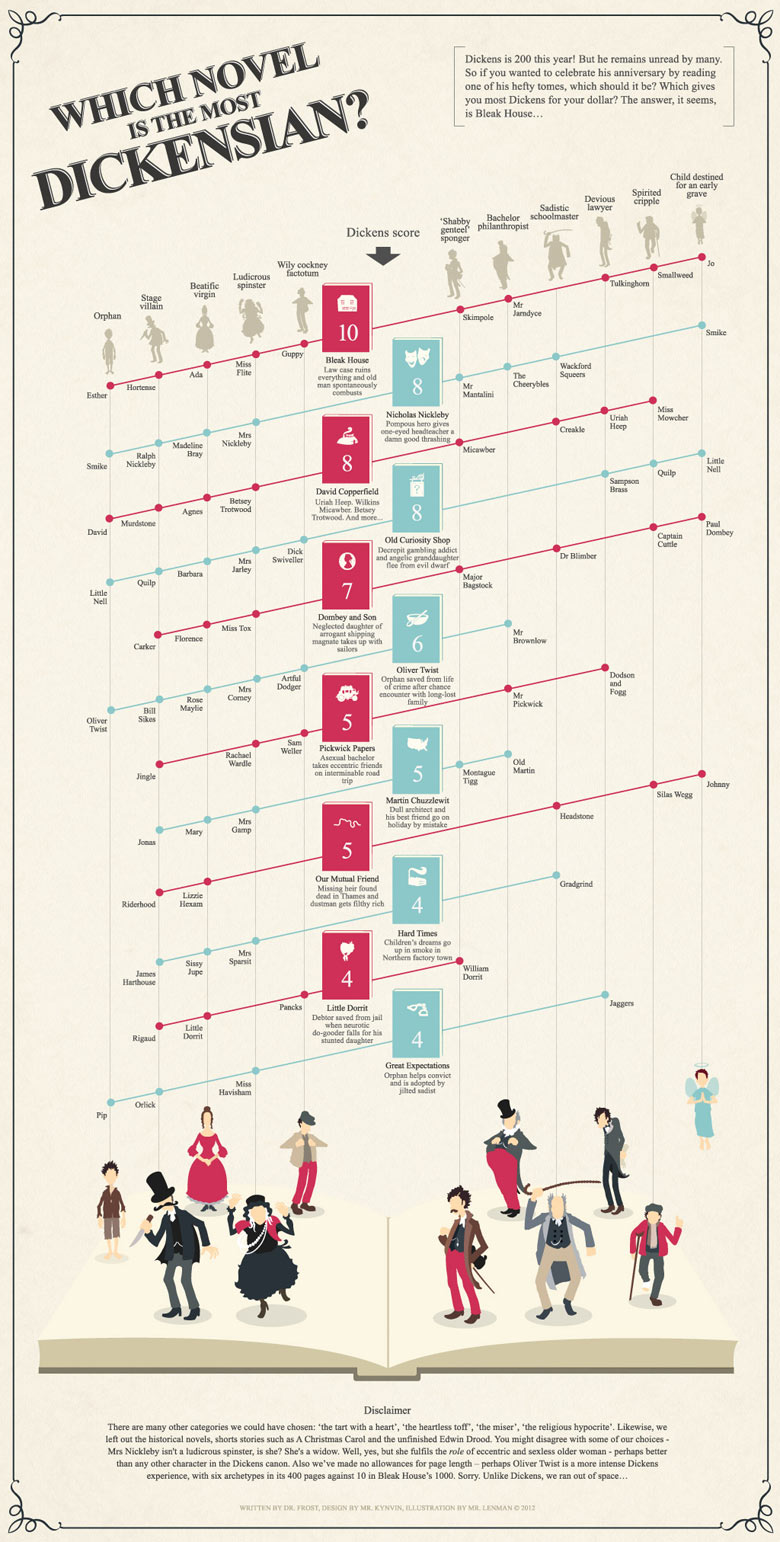
Dickensian Novels
I hope everyone enjoys this graphic. I found it amusing! Follow the link for a closer look.
Saturday, May 19, 2012
Summer and Oliver Twist
It's summer! That means lots of reading, watching TV, and spending time at the community theatre in my case. As for this blog, it means catching up on all the old posts I didn't have the chance to write while I was at college. I'm going to try to post at least once a week and catch up. Expect quite a lot of Shakespeare and Dickens, as those were the two English classes I took last semester.
For the first post, Oliver Twist by Charles Dickens. This is the story of an orphan boy from his birth through his childhood and the many events during that time. While the plot was intriguing and suspenseful, I felt like the story focused more on everyone around Oliver rather than the title character himself. This is shown in the novel through the third-person point of view rather than first through Oliver's eyes. We rarely see inside Oliver's head. Therefore, Oliver seems more like a flat angelic archetype than a three-dimensional character. He is pure, even when everything around him is corrupted. This was my main complaint about the book. I had trouble connecting with a character that didn't seem human. In fact, the "bad" characters like Fagin, the Artful Dodger, Nancy the prostitute, and Bill Sikes were far more interesting and relatable.
This book was published in monthly installments from 1836-1837. The only novel proceeding it in Dickens's career was Pickwick Papers. At this time, Dickens was still trying to figure out what worked in his writing and publishing and what the readers desired. It is easy to see the progression of his writing and business skills when you read later works, like Great Expectations (post to come later). He relies more on characters than plot, usually, to develop his themes.
Oliver Twist is usually noted for its social themes. The novel shows the terrible conditions of the poor and orphans and demonstrates the skewed justice system in London. The settings in the novel are realistic because Dickens would walk those streets himself, searching for inspiration. But, many of the rich people that read his novels assumed that such places were fictional because they couldn't imagine that those poor conditions could be a reality to anyone. For example, Fagin and the rest of his group must steal to live, which Oliver finds abhorrent. Many of the rich upper class saw themselves in Oliver and his puritanical virtuous nature. This means that they would have also shared many of his views on the poor and the justice system in London.
Overall, Oliver Twist was a rather predictable novel. Dickens liked pleasing his audience and everything in the novel is wrapped up nicely with a neat bow. All the small details are interconnected in an unrealistic trait, but that's a typical Dickensian trait. If you're looking for a journey through Dickens or a plot-based read, I would recommend starting with Oliver Twist. But if you're looking for one novel to typify Dickens, it wouldn't be this one.
Happy reading and DFTBA!
Nadia
For the first post, Oliver Twist by Charles Dickens. This is the story of an orphan boy from his birth through his childhood and the many events during that time. While the plot was intriguing and suspenseful, I felt like the story focused more on everyone around Oliver rather than the title character himself. This is shown in the novel through the third-person point of view rather than first through Oliver's eyes. We rarely see inside Oliver's head. Therefore, Oliver seems more like a flat angelic archetype than a three-dimensional character. He is pure, even when everything around him is corrupted. This was my main complaint about the book. I had trouble connecting with a character that didn't seem human. In fact, the "bad" characters like Fagin, the Artful Dodger, Nancy the prostitute, and Bill Sikes were far more interesting and relatable.
This book was published in monthly installments from 1836-1837. The only novel proceeding it in Dickens's career was Pickwick Papers. At this time, Dickens was still trying to figure out what worked in his writing and publishing and what the readers desired. It is easy to see the progression of his writing and business skills when you read later works, like Great Expectations (post to come later). He relies more on characters than plot, usually, to develop his themes.
Oliver Twist is usually noted for its social themes. The novel shows the terrible conditions of the poor and orphans and demonstrates the skewed justice system in London. The settings in the novel are realistic because Dickens would walk those streets himself, searching for inspiration. But, many of the rich people that read his novels assumed that such places were fictional because they couldn't imagine that those poor conditions could be a reality to anyone. For example, Fagin and the rest of his group must steal to live, which Oliver finds abhorrent. Many of the rich upper class saw themselves in Oliver and his puritanical virtuous nature. This means that they would have also shared many of his views on the poor and the justice system in London.
Overall, Oliver Twist was a rather predictable novel. Dickens liked pleasing his audience and everything in the novel is wrapped up nicely with a neat bow. All the small details are interconnected in an unrealistic trait, but that's a typical Dickensian trait. If you're looking for a journey through Dickens or a plot-based read, I would recommend starting with Oliver Twist. But if you're looking for one novel to typify Dickens, it wouldn't be this one.
Happy reading and DFTBA!
Nadia
Friday, February 17, 2012
Tumblr
So, I gave into the the internet peer pressure and made a Tumblr. I'm going to post my blogs on there as well from now on. But, I will still be posting on here first. There will also be lots of Harry Potter, Nerdfighter, Doctor Who, and other general internet things, as well as posts from my personal blog (hopeandheart21.blogspot.com). If Tumblr is your thing, come join me on there at NadiaBlogs21.tumblr.com!
DFTBA and Best Wishes!
Friday, February 10, 2012
Henry V
In the past school year, I've read Henry V by William Shakespeare twice. On both of those occasions, I've written papers. So, in leiu of my regular posts, I present the papers for my Honors and Shakespeare courses. There will be spoilers for the content of the play, but I highly recommend that you read or see them if possible. Also, the Kenneth Branagh movie version is on Netflix and is fairly accurate. (Note: the formatting of the second essay is wonky, I know. But that's what the professor wanted.)
Honors:
William Shakespeare’s The Life of Henry V is a tale of war, bloodshed, and the rights of nobles. But, in the play, the focus also switches to moments to a view of common characters that Shakespeare’s audience would have been familiar with from the earlier historical plays. These opposing vantage points, paired with a view of the French as well, makes The Life of Henry V, not only a play about King Henry, but also about all of the other groups of people that participate in this war. Beginning with Act II and continuing through the rest of the play, the scenes alternate between these different groups of people. Through this, it can be noted that Shakespeare intended this work to be one that portrayed warfare in a manner that was less biased than other plays.
The opening scene of Act II is one that depicts the group of common English soldiers. These men were friends with King Henry when he was known as “Prince Hal” in his earlier days that were full of revel. One of their number, John Falstaff, is dying from the rejection that he suffered at the hands of the king. The audience would have taken note of this death because they met and formed a bond with the comedic character in an earlier play. Also, in this scene, we meet three common soldiers and a boy that will reappear when they fight in France.
Another group of characters that appears is the group of English nobles, composed of King Henry and his lords. This set of characters is, obviously, not out of the ordinary in a play entitled The Life of Henry V. Furthermore, the remarkable character of this group is King Henry himself. In Act IV of the play, in the night before the battle, Henry pretends to be a common soldier. During this time, he and a soldier named Williams converse about the king and the upcoming battle. Henry points out to the common soldiers is a man, like any other when he says, “Therefore, when he sees reason of fears as we do, his fears, out of doubt, be of the same relish as ours are” (IV.i.110-112). This serves to prove one of the themes of the play, that while all men might have different stations in life, they are still human men and can die the same as any other.
In Shakespeare’s The Life of Henry V, the audience sympathizes for more than just the king, as would be expected. Instead, they form connections with characters from different stations in life, ranging from common thief, to reveler, to the king himself. With this, Shakespeare humanizes the many participants in war and gives “the masses” of common soldiers faces to recognize. While there will be no work ever presented that gives an unbiased view of a topic as controversial as war, Shakespeare’s play is one that is more even than the others because it depicts the war from different vantage points.
Shakespeare:
Henry V by William Shakespeare is a play that tackles themes including war and nobility. But, it is mostly a play about the character of King Henry and how he copes with the trials of being the sole ruler of a nation, specifically one in war during the course of the play. But, it must be noted that the audience in Shakespeare’s time already knew the character of King Henry as “Hal” in Henry IV, Parts 1 & 2. They see his character develop from an irresponsible boy to a man who is held accountable for an entire kingdom. King Henry is shown in a variety of situations throughout the course of the play. He takes advice from clergymen and advisors, orders the execution of Bardolph, speaks with soldiers in disguise, soliloquizes to himself, and discusses love with Katherine. The entirety of the play demonstrates that King Henry V is a strong king, willing to do anything for his kingdom. But, he feels the stress of that responsibility and will go to great lengths to prove that he is not the reckless “Hal” from earlier in his life.
In IV.i, The infamous “campfire scene” shows King Henry conversing with three soldiers- Bates, Court, and Williams- while in disguise. Towards the beginning of this scene, Henry points out that the king is a man just like the soldiers. He says that, “I think the king is but a man, as I am… all his senses have but human conditions… in his nakedness he appears but a man…” (92-94). He continues with this short speech with pointing out that the king also has more responsibilities than a common soldier because, “no man should possess him with any appearance of fear, les he, by showing it, should dishearten his army” (98-99). The soldiers and Henry go on to argue if a soldier killed in battle is on the conscience of the king. Henry strongly emphasizes the point that “every subject’s duty is the king’s; but every subject’s soul is his own” (145-146). Once the men leave, the king continues to think upon this argument with a soliloquy. He considers the duty of a king and how much they are expected to bear by their people for so little a reward. He states, “upon the king! Let our lives, our souls, our debts, our careful wives, our children, and our sings lay on the king! We must bear all. O hard condition!” showing the pressure that he is placed under (185-188). He goes on to say that all a king gets in return is worthless ceremony. Also, he stresses that a poor slave that does physical labor all day sleeps sounder than the king because he does not have to worry about the welfare of so many people and that none of the ceremony or special items that the king is privileged to is worth the lack of sleep. In the final section of the soliloquy, Henry appeals to God to keep his soldiers alive through battle the next day and wishes to atone for the bloody sins of his father.
In the context of the entire play, the campfire scene gives the audience the chance to view Henry when does not have to bear the full responsibility of his title. This is the only time when he converses with people that are not aware of his identity and delivers a soliloquy. In this scene, the audience can hear his true thoughts without the judging from another party on the stage. This scene contrasts many of the other situations that we see Henry in throughout the play. He is adamant in trying to convince the soldiers that the king does not hold responsibility for their souls if they are killed in battle. This combined with the prayer in the end, show that Henry is not the strong and ruthless king that he is portrayed as when he orders the execution of the traitors, and later of his old friend Bardolph. He is allowed to curse the office that he holds and discuss the fears that he has for the upcoming battle. The campfire scene is a unique perspective into the true nature of the character of Shakespeare’s Henry V, and is one more piece of the puzzle that is the many facets of Henry’s character and what it means to be a true and just king, no matter the responsibilities or trials he must undergo.DFTBA and Happy Reading!
Nadia
Subscribe to:
Posts (Atom)